
Written by - 3thirds Inc team
August 17, 2026
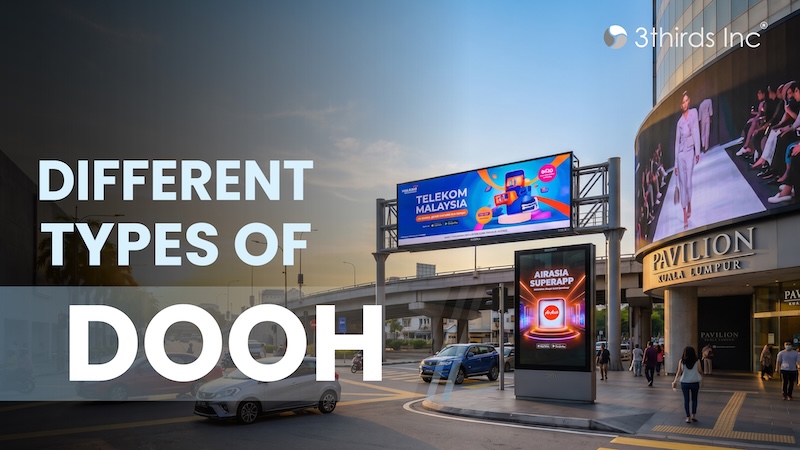
Not all DOOH screens are the same. A rotating digital billboard on the LDP, a lobby screen in a Damansara office tower, and an audio-enabled LED panel inside KL Sentral reach different audiences, at different moments, with different creative needs.
If you’re evaluating DOOH as a channel for the first time, getting the format right matters more than any single creative decision you’ll make afterwards. Here’s how the landscape actually breaks down, and how to match a format to what you’re trying to achieve.
The Main DOOH Format Categories
The mistake most first-time DOOH buyers make is picking a screen size before picking an audience. This usually surfaces later as a campaign that reaches lots of people who were never going to buy anything.
DOOH formats are grouped by location type, and each category carries a different footfall profile, dwell time, and audience mindset. Getting this right shapes everything else about the campaign.
- Large-format roadside LED screens: the digital version of a highway billboard. High traffic, short dwell time, best for one clear message delivered in under 10 seconds.
- Transit and transport hub screens: placed inside or near train stations and bus terminals, where people are waiting or navigating and tend to be more attentive.
- Mall and retail screens: atriums, lift lobbies, food courts, and store entrances, reaching people who are already in a buying mindset.
- Street-level and pedestrian screens: smaller format, closer to eye level, well suited to local businesses with a defined catchment area such as a clinic or a gym.
- Office and commercial building screens: lobby and corridor screens skewing towards working professionals, useful for B2B campaigns.
Static vs. Dynamic vs. Interactive DOOH: What’s the Difference?
Within any one location, the screen’s capability decides what kind of creative you’re allowed to run and how much control you get over when it shows. That matters more than the location itself once you’ve narrowed down where to advertise.
Static DOOH is the simplest format: one creative on a fixed loop with other advertisers for a set booking period. It’s the most common entry point for brands new to the channel.
Dynamic DOOH changes the creative based on a trigger, most often time of day. A café can run a breakfast promotion at 7 am, switch to a lunch offer at noon, and return to brand awareness by evening, all from the same screen and all managed remotely.
Interactive DOOH goes one step further, letting the audience engage directly through touchscreens, QR codes, or motion sensors. Dwell times and recall are both higher, but it only works in locations where people actually have time to stop.
The KL Sentral AdPanels show what dynamic DOOH looks like at a premium location: audio-enabled P6 LED screens with day parting, reaching 1.95 million unique visitors in Q2 2026 (April to June) alone. The audio element is rare in Malaysian DOOH, which means your ad gets to speak as well as show up, in an environment where most screens are silent.
That quarter also saw a frequency of 7.35, meaning the average visitor encountered the panels more than seven times across the period. For a dynamic campaign running different creative at different hours, that repeat exposure is exactly what makes the time-of-day approach worth the extra planning.
How DOOH Inventory Is Sold in Malaysia
Which buying route you use determines how much flexibility you get, and it’s worth knowing before a media owner walks you through their rate card.
In a direct deal, you negotiate with the screen owner, agree on a booking period and a number of slots, and your creative runs on a fixed schedule. Most DOOH campaigns in Malaysia are still bought this way, and it works well when you have a specific location in mind.
Through a programmatic platform, you buy inventory via an automated system, similar to how you’d buy digital display or YouTube ads. You set audience parameters, time windows, and a budget, and the platform handles placement.
Not every screen in Malaysia is connected to a programmatic network yet. Premium transit locations are furthest ahead, while street-level and smaller retail formats are typically still direct-booking only.
Either route usually starts the same way: you contact the media owner or their agency, confirm which formats and locations are available, and ask what audience data they can share before you commit any budget. A network that can only quote you a screen size and a weekly rate, with no footfall figures behind it, is worth approaching with some caution.
Choosing the Right Format for Your Campaign Goal
The right format depends on what you’re trying to achieve and who you’re trying to reach, not on which screen looks most impressive in a proposal deck.
- Brand awareness at scale: large-format roadside or premium transit screens, for high reach and one clear message.
- Local audience targeting: street-level screens in specific neighbourhoods, best for businesses with a defined catchment area.
- Professional or B2B audiences: office building lobbies in commercial hubs like KL Sentral, KLCC, or Bangsar South.
- Integrated campaigns: programmatic DOOH running alongside Google or Meta, so the physical screen reinforces the digital message.
- High-engagement activations: interactive formats with QR codes or touchscreens, for product launches built around an immediate action.
For most Malaysian businesses approaching DOOH for the first time, a transit or transport hub screen is the most practical entry point. It offers a defined audience, measurable footfall, and the option to run dynamic creative without a large minimum spend.
Frequently Asked Questions
The main types are large-format roadside LED billboards, transit and transport hub screens, mall and retail screens, street-level pedestrian displays, and office building lobby screens.
Each has a different audience, dwell time, and creative requirement, so the right one depends on your campaign goal rather than the screen’s size or location alone. Matching format to audience matters more than matching budget to screen size, especially for a first DOOH campaign.
It’s a DOOH screen that lets the audience engage directly through a touchscreen, a QR code, or a motion sensor.
Interactive formats generate higher recall than standard rotating creative, but they work best in locations where people have time to stop and engage. They’re also more complex to produce and run, so they suit specific campaign types, such as a product launch, rather than general brand awareness.
A DOOH network is a collection of screens managed by a single media company and sold as individual placements or as a package across multiple locations.
You can book directly with the network owner, or through a programmatic platform that lets you buy inventory across several networks based on audience, time, and location. Which route makes sense depends on how much control versus flexibility your campaign needs, and whether the screens you want are programmatic-enabled yet.
A digital billboard is a large-format LED screen in a roadside or highway location, while a DOOH screen is the broader category covering every screen-based ad format in public spaces.
That means all digital billboards are DOOH screens, but not all DOOH screens are digital billboards. Transit panels, mall atrium screens, and office lobby displays all fall under DOOH without technically being billboards, and each behaves quite differently from a planning perspective.
Want to Find the Right DOOH Format for Your Campaign?
Understanding the format landscape puts you in a much better position to judge whether a specific placement is worth the investment, and to see which one actually suits your audience.
3thirds Inc operates the KL Sentral AdPanels, a premium audio-enabled DOOH placement inside Malaysia’s busiest transport hub, and works with brands on integrated media strategies across OOH, digital, and programmatic. We’d love to chat about which format fits your campaign. Visit the KL Sentral AdPanels page for placement details and current audience data.